
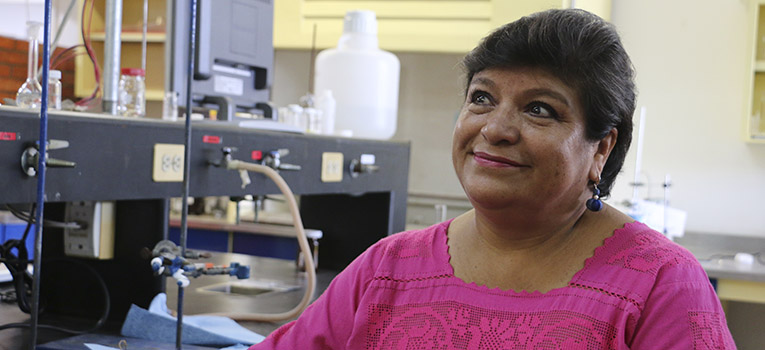
Guanajuato, Gto. December 26, 2018.- "A country like ours needs science and not necessarily in research, it can be in the industry, to solve the problems that sometimes are very easy to solve from the basic principles", considers Dr. Silvia Gutiérrez Granados, professor of the Department of Chemistry of the Division of Natural and Exact sciences of the Guanajuato Campus.
Precisely, there is a difficult stage in the energy field, because much of the economy is based on the oil sector that has great ups and downs. To counteract this thought it is necessary to work and try to find a solution, therefore the researcher of the National System of Researchers (SNI) level II and responsible for the academic body of environmental electrochemistry, leads the Research on the development of organic photovoltaic cells.
Renewable energies are a good alternative, and solar energy. Therefore, the academic body that leads the project "electrosynthesis and characterization of photovoltaic materials based on polythiophenic systems with insertion of carbonaceous materials", through which new photovoltaic materials are sought Organics that help to increase the efficiencies of the organic solar cells (CSO).
The direct benefit of the organic photovoltaic cells for the citizenship is the saving of energy taking advantage of the sunlight to heat the water, to turn on the lights, among other things; at the industrial level it is envisaged to lower production costs.
"We want to make these thin films of conductive polymers, which are the active layer of this cell by electrochemical methods. This method allows us to adhere to the conductive glass and can have that flexibility, which are called light, "explained Dr. Gutiérrez Granados.
This study aims to reduce costs and that these energy collectors can be built in large quantities, in order that the population can access this type of technology, which is currently very expensive.
The solar cells are made by inorganic compounds and with materials of high economic cost and are not flexible; The essential feature that is sought is to create them with organic material, said Dr. Silvia.
One of the challenges of the organic cells is the reduction in their manufacturing costs, increasing the efficiency of solar energy conversion in electricity and achieving a greater life time; Combined with the elaboration of these very fine films with low roughness and thicknesses of 100 nanometers maximum.
The mechanism for the conversion of energy can be explained by 4 steps: 1) The solar energy affects the anode, which absorbs it in the form of photons, 2) the electrons of the active layer are excited by the photons, 3) due to the difference of energy , the electrons pass from the donating material to the acceptor and finally, 4) the load transport and the collection, the cathode does.
For Dr. Silvia Gutiérrez a referent is the support of the UG that always gives information on where to touch doors, grants a budget for research, has opening for supports such as stays, congresses, helps students to participate in forums and can broaden their vision at the international level.
After 30 years of career teaching and conducting undergraduate, master and doctoral thesis, he stressed that "chemistry is everything to me, because we are alive for all chemical reactions. I've always liked science, and chemistry is very versatile; I like to work with young people and with the example of professionalism of ethics and openness of visions to improve our environment."
Photo gallery