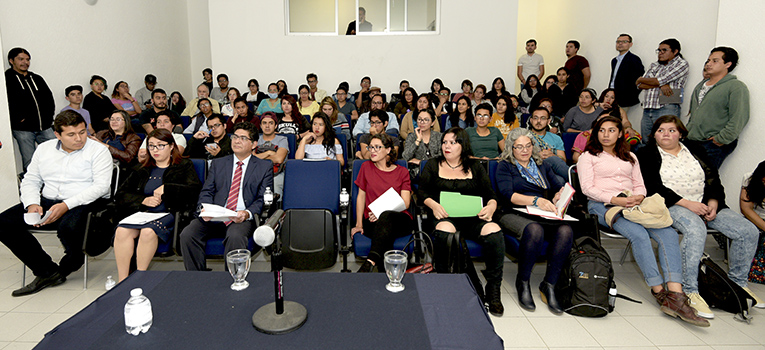
León, Gto., February 12, 2019.- In order to account for the diversity of expressions and religious practices of the state of Guanajuato, the University of Guanajuato (UG) Campus León received two outstanding social anthropologists, who presented to the student community their ethnographic work relative to the cult of the Holy Death.
The research duo composed by Dr. Hilda Maria Cristina Mazariegos Herrera, graduate of UG's Campus León, teacher and doctor of anthropological sciences and Blanca Mónica Marín Valadez graduated from the University of Veracruz and PhD student of Mesoamerican studies at the National Autonomous University of Mexico (UNAM), are active members of the network of researchers of the religious phenomenon in Mexico.
It should be noted that this presentation is part of the program of dissemination and promotion of the educational program of social anthropology to invite the young people to study this degree that is based on the anthropological methodology and the field work, with capability for abstraction, analysis and synthesis of social reality.
During the talk, the social investigators realized the spaces that so far have been identified as important in the reproduction of devotion, specifically in the pilgrimage that a group of devotees of León carried out in the municipality of Manuel Doblado, Guanajuato on July 1st, 2017.
Cristina and Mónica shared that the devotion to un-recognized saints by the catholic hierarchy is becoming increasingly visible and is in an accelerated process of expansion both nationally and internationally, so in their talk they sought to reflect on how this religiosity is lived.
On the other hand, they presented the influence of the migration of people from other States of the Mexican Republic to the city of León, who installed altars in honor of the Holy Death thus transmitting this fervor; In the same way, the electronic media strengthen this cult through social networks which results in a network of devotees from the municipalities of Manuel Doblado, León, Romita, San Francisco del Rincón and Valle de Santiago.
In this regard, Blanca Mónica Marín called on the anthropologists to "approach the religious phenomenon of the state of Guanajuato, as there is a reference work like Cristina, which portrays religious diversity in León, and I think it is something that should be continue developing in anthropological practice."
Cristina Mazariegos said that the main challenge of his research had to do with his own prejudices and fears about the believers practicing the cult of the Holy Death, regarding them said that "from the first moment we opened the Doors of his house, showed us the altars; they are people who also have a lot of need for them to know about their cult and to have their prejudices removed from them."
Referring to why young people are encouraged to study social anthropology, they both agreed that it is a way of life that allows us to know other spaces, other cultures and enrich one's life and meet the other.
"Anthropology opens up the world, your own world because you know yourself and recognize yourself in the context in which you grow, in your life story, but also opens the world to others, the world of others (...) The postulate of anthropology is to portray diversity and when you portray diversity then you recognize the different ones," concluded Dr. Cristina Mazariegos.
This activity was promoted by the Academic Committee of Social Anthropology of the Department of Social Studies of the León Campus, integrated by Dr. Ileana Schmidt Díaz de León, Dr. Luis Miguel Rionda Ramírez, Dr. Maricruz Romero Ugalde, Dr. Ivy Jacaranda Jasso Martínez, also, Dr. Jessica María Vega Zayas, Dr. Rubén Ramírez Arellano and Dr. Claudia Gasca Moreno.
Photo gallery