
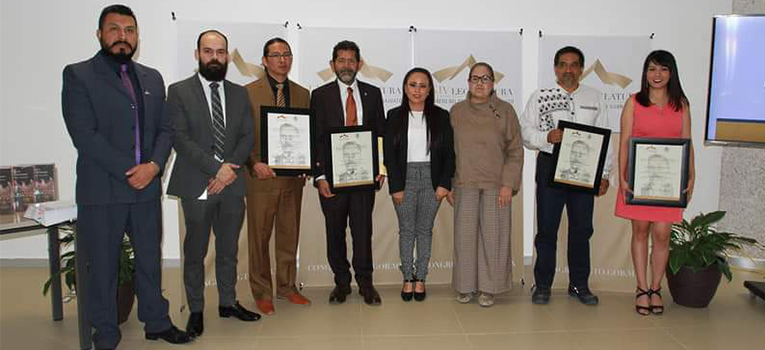
Guanajuato, Gto., April 10, 2019.- The Doctors José Luis Lara Valdés and Fernando Díaz Pérez, outstanding professors of the Guanajuato Campus of the University of Guanajuato (UG), obtained the first and second place, respectively, in the essay contest of legislative investigation convened by the Congress of the State of Guanajuato.
This is the essay contest of legislative research "Dr. Pablo Bustamante" under the theme "Guanajuato, heading to the 500 years of the Mexican municipality 1519-2019" which convened the LXIV local Legislature and the Institute of Legislative Research. The rating jury was integrated by Ma. Guadalupe Guerrero Moreno, Juan Elías Chávez and Ernesto Camarillo Ramírez.
The winning essays were the following: "Histories of Municipalities of Guanajuato" by José Luis Lara Valdés, first place; "A municipality for the 21ST century" by Fernando Díaz Pérez, second place and "6 lessons in the field of human rights for the municipal police" by Abraham Sánchez Ruiz, won third place.
The award ceremony was attended by Dr. Teresita de Jesús Rendon Huerta Barrera, rector of the Guanajuato Campus; Dr. Claudia Gutiérrez Padilla, academic secretary of the Campus.
Histories of the municipalities
In an interview, Dr. José Luis Lara Valdés, professor of the Guanajuato Campus, shared that the text with which he participated in the contest is called "histories of Municipalities of Guanajuato", and that he was interested that the call was in a frame of studies of legislative investigations, because it allowed him as historian, to reflect historical aspects, but in the theories of political sciences.
Also, the municipality, which also has a good number of global proposals, which has been able to even share reflections with the rector of the Campus Guanajuato, who has promoted municipal studies with its center Cívitas A.C.
The approach of his text is as follows: the municipalities of Mexico assume to have the origin of the Republic, i.e., the first constitution of 1824, but historically there are municipalities that have a historical structure earlier and in the case of those of Guanajuato the Territory is almost the same as it was allocated in 1786 to the major quartermaster and current municipal entities, as they are listed in the Political Constitution of 1826 of Guanajuato, in turn have a historical trajectory since the 16th century.
In this case León, Irapuato, Salamanca, Celaya, San Felipe, San Miguel, Guanajuato, Pénjamo, Yuriria, San Luis de la Paz, Victoria, San Felipe, already existed in the 16th century as public administrations called "mayoral municipalities", plus a distinction of a very interesting theory policy, because some are "Republic of Indians" and others are "Republic of Spaniards".
The interesting thing is that the rules given for them to be constituted, they authorized the peoples "Republic of Indians" to have their own authorities elected by the same inhabitants of the territory: governor, justices, notary and representative before the vice regal authorities whereas those of "Republic of Spaniards" were imposed the authority by appointment of the King of Spain.
Dr. Lara considered interesting to emphasize through the history, that in Mexico we have municipalities that far from beginning in 1824 or 1826, already have a historical trajectory like institutions of administration, yes called municipal, but like "peoples of Indians".
It is what is exposed in the essay, revealed, because there was no time to develop historical lines and argue them with documentary evidence since it is a historical essay of Legislative research, where the direct source is the same law, however, it is Very positive to promote these activities that had an excellent response, with 21 papers presented.
Municipality for the 21st century
Separately, Dr. Fernando Díaz Pérez, Director of the Department of Public Management, agreed that it is very positive that these competitions be encouraged to encourage social science research, a discipline in which there is apparently no innovation, but the Presented work seeks innovation in local governments that are 500 years old and unfortunately some continue to function as then.
He reflected that today globalization is common, technology 4.0, connectivity, but there are problems of migration that generate interculturality, then we need new governmental organizations that respond to social problems, "is the Spirit of this work: a municipality for the 21st century, which is dedicated not only to its tasks which by law correspond to it, but goes beyond. "
In fact, many of the tasks seem to have already been in the norm, he said, but they are projected in a different way; for example, the municipalities are responsible for cultural and ethnic preservation, but not the colors of the party, folklore, but with the use of new technologies, connectivity, even "APPS" to develop culture.
He acknowledged that this is not unprecedented, so much so that there are even works in that sense, as in Oaxaca where there are "APPS" to learn Mixe, Zapotec; In Hidalgo to learn Otomi, to preserve his language, identity and also projected, not as a museum piece, but the usefulness of language for the development of people and their communities.
"In the end there are cultural syncretism, who are going to project us to the future, we are not those Aztecs or Mayans, but there is a culture that must be preserved and respected," said the teacher, who concluded that, in that order, his text is a warning call to the concrete elements from the public administration, of what needs to be changed in the city councils to be really useful in these new contexts.
Photo gallery