
 Guanajuato, Gto., October 20, 2015.- A multidisciplinary group of researchers from different institutions in the country analyzed the negative effect produced by lichen in historical buildings.
With the intention to know which deterioration processes occur in the rocky lichen-substrate interaction; the research took place on the stairway from the central building and the old school of music at the University of Guanajuato.
Besides contributing to the knowledge of deterioration in such edifications, this research provided data on found lichen species, the causes of their growth and the role of these microorganisms –resulting from the fusion of fungi and algae—in the rock wear, with the purpose to implement protection and prevention measures in the buildings.
It is important to mention that Dr. Maria de Jesús Puy Alquiza from the Department of Mines, Metallurgy and Geology from the Engineering Division in the University of Guanajuato –who participated in the research—declared that the buildings are not in risk by the presence of lichen in their structure.
"El rol de las comunidades de líquenes en el deterioro superficial de su sustrato rocoso: studio de la interfase liquen-roca en dos monumentos históricos de la ciudad de Guanajuato, México". (The role of the lichen communities in the superficial deterioration from its rocky substrate: study of the lichen-rock interface in two historical monuments from the city of Guanajuato, Mexico) was the name given to the research that divided in four stages.
The first stage consisted in characterizing the physical and mechanical parameters from the rocky material in which the lichen communities grow. The second stage collected a minimum of five samples from each lichen specie in the chosen sites.
The third stage was identifying the characteristics from the rocks, from their mineralogical composition, its geo-chemistry to how the lichen community acts on it. The lichen-rock interface analysis occurred in the fourth and last stage.
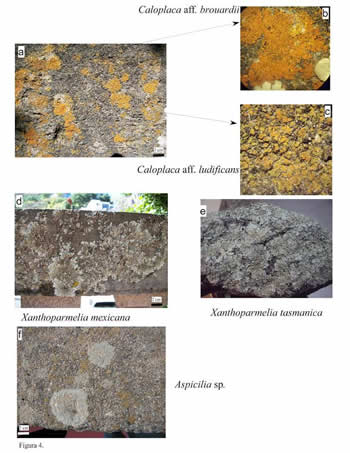
The research identified five lichen species. These penetrate from 0.5 micrometers to 50 micrometers in the construction through their ricin –filaments that grow in the inferior surface of the talo in a foliose lichen and serve to fix to the substrate--, provoking the mineral separation in the rocky surface.
Dr. Veridiana Reyes Zamudio from the Department of Chemistry, from the Natural and Exact Science Division at the University of Guanajuato, participated in the research.}
As well as Dr. Velia Yolanda Ordaz Zubia fron the Department of Architecture, Architecture, Art and Design Division from Campus Guanajuato from UG and Dr. Raúl Miranda Avilés, from the Herbarium from the Faculty of Biology from the "Universidad Michoacana de San Nicolás de Hidalgo"; also, Dr. Ma. del Carmen Salazar Hernández, from the Inter-disciplinary Engineering Unit, Campus Guanajuato from the National Polytechnic Institute, (IPN for its acronym in Spanish).