SINCE 2009, THEY TAKE PAINTING, THEATER, SCENOGRAPHY AND MUSIC TO THE INMATES IN THE STATE CERESO.
Guanajuato, Gto., November 10, 2015. Convinced of the transforming power of art, but above all, of the importance to encourage human contact, a group of students and professors from the University of Guanajuato (UG) teach cultural workshops to the inmates in the ten Centers of Social Rehabilitation (CERESO for its acronym in Spanish) in the state.
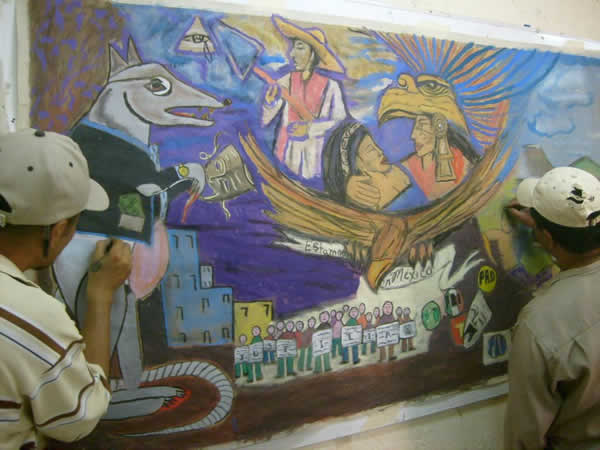
The project emerged in 2009, when a petition arrived to the Direction of Cultural Extension from UG to give a painting workshop in the CERESO from Guanajuato, in the framework of the Cultural Week. The success of this initiative gave origin to an annual program that extended to all CERESOS in the state.
Currently, every workshop lasts one week –20 hrs.—and rotates until it covers all ten centers with the collaboration of six workshop givers. In this way, the inmates (men and women) have been able to take courses of music, performing arts, theater, drawing, painting, mimic, folkloric dance, ballroom dancing, singing, guitar, cardboard work, scenography and elaboration of theater scripts.
Ariadna Rapozo, graduate from the Master degree in Visual Arts from UG and one the pioneers of the program of cultural workshops that are given in the CERESOS, is convinced of the benefits from this initiative. .
The programs help greatly to the social reinsertion of the inmates, besides, the fact they coexist with people outside their environment of violence, can generate a change in them. "It is always important to get to the basics, since a "good morning", "how are you?", these basic rules of humanity that can be forgotten inside. A simple hand shake and a look in the eyes can change a whole day", she sustained.
Although she recognizes that is an uncommon work, she considers herself privileged to be able to enter a jail, share what she knows, learn, and then go out. "I feel I can contribute a little bit to stimulate a different ambiance. What you teach them they can use it or not, but I think we are tryong to go back to the human contact".
Manuel Isab López Carbajo, coordinator of the cultural workshops, agrees with M. Rapozo about the purpose of the program... "we see the inmates as people, and we are trying to collaborate so they can reinsert in society, we do not know what cause brought them there nonetheless we do not mess with that, we see them as people and we try to help them".
She tells about an inmate she knew who liked a lot to participate in the workshops, above all –she remembers—he stood out in the painting workshop. One day she found him working at a bar, where they hired him to decorate the walls. "I was very pleased to see him outside and especially seeing him put in practice what he learned in the workshops", he was very thankful with us, the satisfaction you feel for this it' is indescribable, because it confirms we are contributing in making changes.
Indira Lyzbeth Rivera, who collaborates as workshop giver for six years, assures that participating in this program has allowed her to grow in many aspects, especially in the personal level. Now she values more her freedom, measures the consequences of her decisions and even though she has not been able to eradicate some of her prejudices, "it does help to stop them", she says.
While giving the theatre course, her task is to help them explore their emotions, which constitutes a very strong experience for the inmates. "You feel that you are going, you are with them a week and afterwards it seems they forget about it, but sometimes when I find them outside, you discover they are very fond of you, they are very thankful" .
"I would say that is a workshop of humanity", finalized.