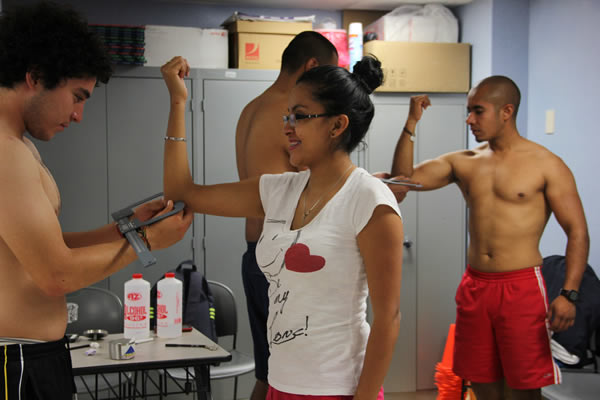
León, Gto., a November 14, 2015.- The academic program in Sciences from the Physical Activity and Health, most known by the university community in Campus Leon as CAFIS, stands out for being the only one in Mexico that addresses the most generalized problems of public health like overweight and illnesses related with a sedentary life style.
This bachelor degree is taught at San Carlos from Campus Leon and has three main axis, teaching who seeks the student to develop competencies to conduct in the scholar ambient in a basic o higher level and develop all aspects of the educative part of the physical activity.
The second axis is the research, where they gather the exact sciences such as basic mathematics, biophysics, and biostatistics, where the scientific support happens, besides opening the panorama for the postgraduate's continuity and specialization.
The sporting part constitutes the third axis; there the students take the basic disciplines such as basketball, soccer, volleyball, athletics and swimming. Is in this area where they develop competencies to transmit knowledges on the adequate practice of sports and ruling, besides living the physical activity of students and professors.
An important aspect of the bachelor degree in Sciences of Physical Activity and Health is the experience of the exchange as complement of their formation. Currently they have students that performed academic stays in Spain, Brazil and United States.
The coordinator for this bachelor degree and doctor in public health, José Guadalupe Montaño Corona mentions that the program develops "a competency that works as the lost link to close the multidisciplinary chain among medic, nutritionist, physical therapist, nurse and psychologist to prescribe the physical exercise, health (prevention or maintenance) and to bring down, intervene and contribute in cases of people with diabetes, hypertension, overweight and in some cases, cancer who require the prescription of physical exercise as part of their treatment and for other illnesses that have the lack of physical activity among their causes".
College authorities approved the academic program in May 2010, and "for the following school term, 20 students from among 59 candidates registered. Precisely, this generation just graduated and three of them already presented and defended their thesis. Two of them graduated with academic excellence, one of the possible forms but preferred the thesis so they could continue their postgraduate studies", mentioned Dr. Montaño.
He added that the current population is approximately 150 students, with an average of 45 students by semester. "The 75% of the teaching staff has a doctor degree, more or less 13% with a master degree and the rest has a major, but above all, they are people who teach and research and practice physical activity", assured the specialist in public health.