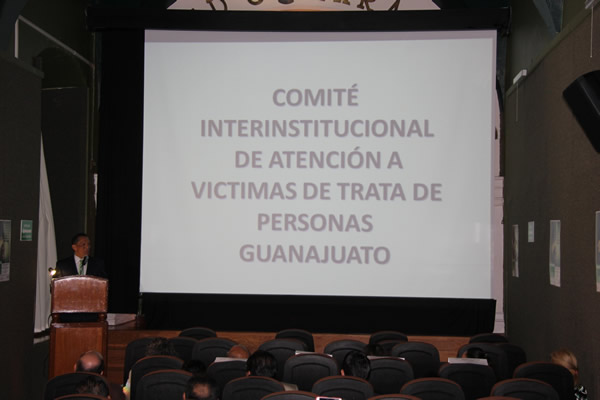
Guanajuato, Gto., November 26, 2015. The University of Guanajuato (UG) was the scenario to show the interinstitutional operational protocol for the state of Guanajuato that seeks to become a tool to prevent, detect, protect and address human trafficking.
The document is a guide not only for public officers but also for any person who is in touch with victims of trafficking, which is considered the most extended crime in the planet and threatens all human rights.
At the presentation, the General Rector from the University of Guanajuato, Dr. Luis Felipe Guerrero Agripino, congratulated the Interinstitutional Committee to address victims from human trafficking for providing this tool that contributes to the protection of exploitation victims.
He remarked that it is very difficult for law itself to enable great transformations in society and this protocol represent the follow up, "What must be done after the legal framework", hence its importance to have this document, pioneer in this matter at a national level.
The President of the committee, M. Germán Estrada Laredo, sustained that the topic of human trafficking, given the dimension of this problem, concerns society. There are 21 million victims in the world and in Latin America, 70% are under 18 years old.
Before the text presentation, the Technical Secretary from the Interinstitutional Committee, Dr. Laura Cuevas Aguilera, showed a diagnosis of the human trafficking crime in the state of Guanajuato. "An inivisble crime with a high level of impunity", which is estimated in more than 92%, although --she clarified—"the absence of any complaint exceeds any statistic".
Human trafficking is considered the XXI century's slavery, and as such, it must be seen and fought, therefore she considered indispensable to have tools like this protocol that includes contributions from public servers and academics.
In her intervention, Dr. Susan Thalía Pedroza de la Llave, who leads the "Comisión Ejecutiva de Atención a Víctimas" (CEAV), said that one of the greatest achievements of this protocol is that it focuses in protecting the victims' rights and fundaments in a regulatory framework and a very clear methodology.
The Interinstitutional Operational Protocol for the state of Guanajuato in the matter of prevention, detection, protection and attention for women, men, children, teenagers and other vulnerable groups, victims from the crimes listed in the General Law to prevent, sanction and eradicate crimes in the subject of human trafficking and to protect and assist the victims of these crimes has four stages: prevention, detection, protection and attention, and includes strategies for each one.
The participant institutions beside the University of Guanajuato were: the CEAV, "Centro de Investigación y Seguridad Nacional" (CISEN); "Policía Federal", the "Secretaría de Trabajo y Previsión Social", the "Procuraduría General de Justicia del Estado de Guanajuato", "Universidad Iberoamericana", "DIF Estatal", "DIF Irapuato", the "Secretaría de Seguridad Pública", the "Instituto Nacional de Migración", the "Casa de Migrante Irapuato", the "Procuraduría de los Derechos Humanos del Estado de Guanajuato", among others.