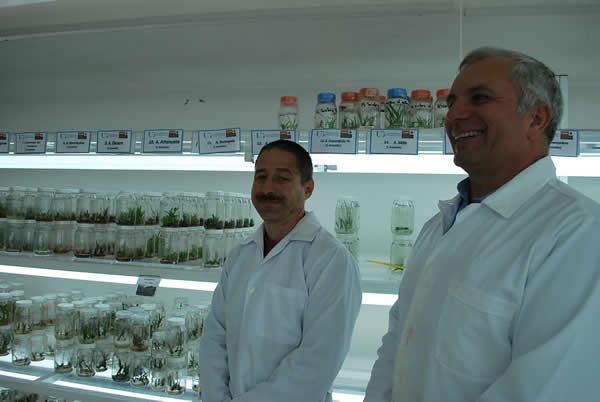
Irapuato, Gto., January 18, 2016.- To collaborate in an automation project of the culture lab of vegetable tissue from the University of Guanajuato –which will allow to reduce production costs--, Dr. José Alfredo Herrera Isidrón, researcher from "Universidad de la Habana", Cuba, arrived to the Division of Life Sciences (DICIVA) in Irapuato.
With support from the "Consejo Nacional de Ciencia y Tecnología (CONACYT)" and by invitation from Dr. Héctor Gordon Nuñez Palenius, professor at the Department of Agronomy and responsible of the Laboratory of Vegetable Tissue Culture, it was achieved for Dr. Herrera to perform a sabbatical in Mexico to consolidate research groups, and also in collaboration with the Professional Interdisciplinary Unit from the "Instituto Politécnico Nacional" Campus Guanajuato.
The visitor, explained that his project "Automatización de sistemas de inmersión temporal para elevar la eficiencia de la micropropagación de plantas del laboratorio de cultivo de tejidos de DICIVA" (Automation of temporary immersion systems to elevate the efficiency of the micro propagation o fplants from the tissue culture laboratory from DICIVA) proposes automated solutions to scientific and technological problems for the laboratory, given that the culture of vegetable tissue has elevated costs and requires laborious tasks.
The culture of vegetable tissue is a biotechnological methodology that allows the in vitro manipulation of cells, tissues and organs from plants. The culture finds its application in in vitro cloning and micro propagations, the production of pathogen free plants and the conservation of germplasm in minimum growth conditions.
Therefore, tissue culture constitutes a real alternative for the better use of plants, increase in quantity and quality of food, as well as obtaining new vegetable origin products with application in biotechnological, pharmaceutical and cosmetic industries.
Since the micro propagation protocols are expensive and laborious, the automation alternative using bioreactors of temporary immersion, sensors and automatic control, is proposed as an alternative to diminish the production and energetic costs.
It is important to mention that Dr. Herrera's work considers requesting a patent derived from this work, the production of two articles, a course, two seminars and train professors and students that participate in the project, in the development of skills related to intellectual property.