
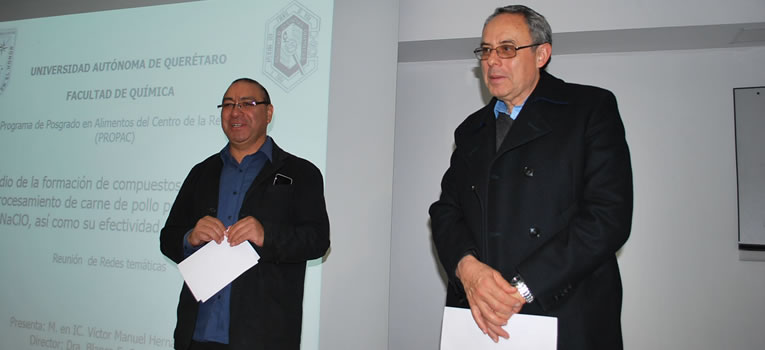
Irapuato, Gto. February 12, 2016.- Researchers from the University of Guanajuato (UG), "Universidad Autónoma de Querétaro (UAQ) and the "Universidad Autónoma del Estado de Hidalgo (UAEH) presented progress related to the Food Biotechnology Network in a session in the Division of Life Sciences on Campus Irapuato-Salamanca from UG.
This network is composed of three academic bodies: Agricultural Biotechnology from UG, Biotechnology from UAQ and the academic body of UAEH.
During the second reunion of the third year of financial support from the Programs for the Development of the Teaching Development of the Secretary of Public Education (PRODEP), they presented seven research papers in the food area.
The presented topics were: "The molecular identification and visualization of the microbial consortium of Mexican Kefir", "Formation to toxic compounds generated during the meat processing" and "Employment of casein micelles for the encapsulation of sesamol".
They also presented the study of "Physical-chemical, nutritional and functional characterization of xoconostle in Mexico", "Study of the antimicrobial peptides of broccoli and its use in the formation of edible coatings", "Application of the bioluminescence to measure nisin in chesee" and "Possible regulation of the antimicrobial peptide Thurincin H(m)".
The hosts were Dr. José Eleazar Barboza Corona, leader of the Academic Body of Agricultural Biotechnology and Dr. Ruben Salcedo Hernández, both professors in the Department of Food from the University of Guanajuato and members of the cited academic body.
There was also the participation of Dr. Carlos Regalado González, VP of the Mexican Society of Biotechnology and Bioengineering, of Dr. Blanca Estela García Almendárez and Dr. Silvia Lorena Amaya Llano, both professors from the Faculty of Chemistry of UAQ. To the work session Dr. Rafael Germán Campos Montiel and Dr. Alma Delia Hernández-Fuentes from UAEH added.
Also present in the meeting were undergraduate and postgraduate students of the participating institutions, who gathered in the Division of Life Sciences located in the community El Copal in Irapuato.