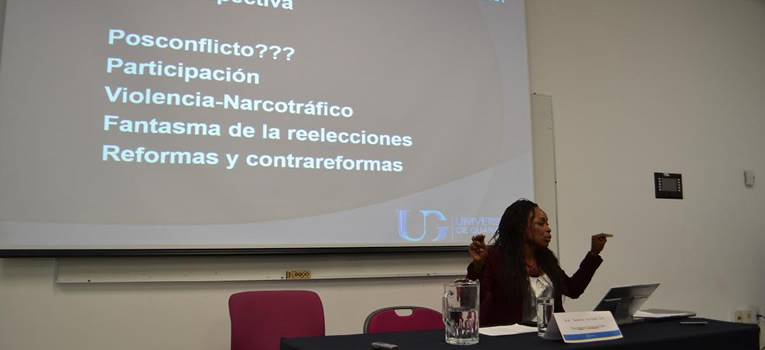
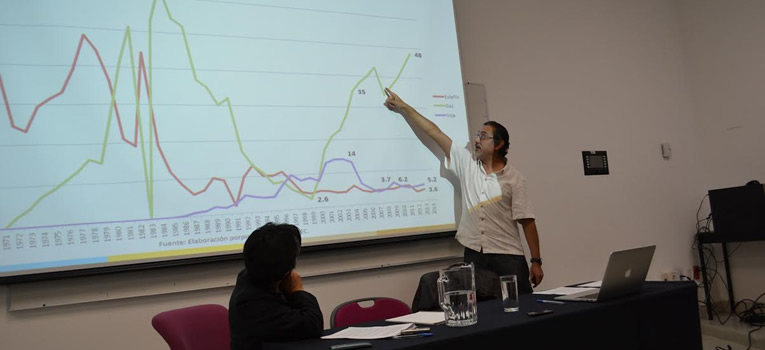
León, Gto., March 1, 2016.- The University of Guanajuato, Campus Leon was the stage for the making of the Latin American Seminar "Paradigmas de Democracia en América Latina en la transición del siglo XX al siglo XXI" (Paradigms of Democracy in Latin America in the transition from c. XX to c. XXI".
The attendees, mostly students from Social Sciences, knew the cases of democracy in countries like Brazil, Colombia, Mexico, Argentina and Venezuela. Experts analyzed the scenarios of each country and described the factors that have presented in each case, as well as the democratic path that each nation could possibly take, just as the similarities and differences that present in the region.
They will analyze aspects such as the economic growth, social inequality, poverty, impact of mass media, social networks, candidacies, independencies, economical models, citizen participation in electoral processes, the influence of the business sector, trends and paths of each country. Besides they covered topics related to human rights and forced disappearances in the Mexican case.
Dr. Monica Elivier and Dr. Ángel Serrano Sánchez, both researchers-professors of the Division of Social Sciences and Human Studies addressed the case "Ayotzinapa" and the problems in Mexico, such as organized crime, found clandestine graves and disappeared students.
Researchers addressed the presented scenarios in Argentina, in charge of Dr. Juan Russo; Venezuela, by Dr. Armando Chaguaceda; Brazil, presented by Dr. Luciane Loss; Colombia, in charge of Dr. Teodora Hurtado; Bolivia, presented by Dr. Carmen Rea and Dr. Eloy Mosqueda and Mexico by Dr. Alex Caldera. All the researchers made a general analysis on democracy, the factors that decayed the government of each one of the presented countries, the comparisons among each other and the possible solutions.
Equally there was a historical panorama of the citizen participation in the democratic processes in the different Latin American countries and the possible previous scenarios to electoral processes to choose presidents of the nations in the zone, where the vote of punishment seems to be a constant for the democratic changes.
Finally, the analysts made a retrospective of the last years in which the alternatives in the Latin American governments have created the path so the citizen participation be more active every time and allows the incipient democratic transition with the objective to provide the university community and public with objective information for a responsible democratic participation.