
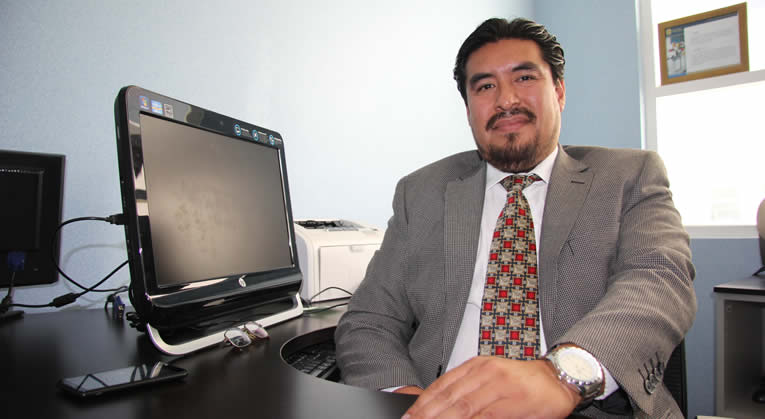
Guanajuato, Gto., March 10, 2016.- With the objective to improve the quality of the patients with type 2 diabetes, the University of Guanajuato (UG) in collaboration with the University of Colorado, prepares a project that pretends to evaluate the effects of exercise and physical activation as one of the pillars of attention for such disease.
The project is led by Dr. Maciste Habacuc Macías Cervantes, professor-researcher of the Department of Medical Science at UG, who points that type 2 diabetes is one of the most frequent diseases in Mexico, approximately between the 8% and 10% of the population suffers it, that is why there is the need for a better treatment in people that are in this condition.
His proposal fundaments in boosting the physical activity and the adherence to exercise, from the measurement of serum lactate levels, meaning, use this element as an indicator hemodynamic indicator in cardio and blood flow functions. In this way, you obtain a more reliable guide and a more precise control to evaluate levels in patients, nor like the measurement of the cardiac frequency as usual.
Dr. Macías Cervantes points out that one of the purposes of the project is to prove that the metabolic control, based in the lactate, is a better option. If confirmed, there will be a recommendation to all the population with diabetes, beginning by the city, the state and later the country, so they train under these criteria; since that would create a better metabolic control, more stable glucose numbers in adequate ranges, avoiding complications derived from the own disease.
He indicated that the importance to take care of the patients with diabetes relies in avoiding a high state of glucose damages kidneys, eyes and sensibility; therefore, it requires a greater adherence to exercise like a habit.
For the execution of the project, there will be an investment of approximately MXN $200, 000, in a 2-year lapse. Its implementation requires the work of two groups of patients with diabetes: one training based on lactate and the other in cardiac frequency.
In this intervention, firstly, the patients will be valued completely, parting from their metabolic parameters, glucose, cholesterol, seeking an appropriate control. During the evaluation, food and intensity of training will be controlled using lab equipment and an ergometer, as an instrument to make strength tests, with the proper resistance. An in the end, there will be the possibility to determine the best alternative.
To conclude, Dr. Macías Cervantes explains that besides the timely exercise, it requires a proper medication and nourishment. If a patient with diabetes maintains active, it will have best muscular strength and, therefore, a best quality of life.