
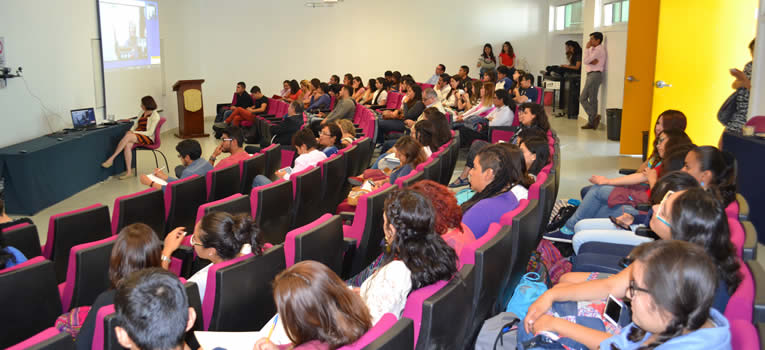
León, Gto., April 7, 2016.- The renowned researcher Martha Schteingart participated in the videconference "Desigualdad socio-espacial en grandes ciudades. Algunas comparaciones" (Social-spatial inequality in large cities. A comparison), in which she exposed the results from the research on inequality that exists within the population of low and high resources, as well as the disadvantages from the location of housing, of the less favored sectors.
This conference was given in the Division of Social Sciences and Human Studies at Campus Leon from the University of Guanajuato (UG), within activities of the Seminar "Emerging Social and Dynamic Change in Latin America," coordinated by Dr. Alex Caldera and Dr. Jesica Vega, both professor-researcher from the Department of Social Studies.
UG students, met the comparative study of four major cities across the country; Puebla, Guadalajara, Monterrey and Distrito Federal (now CdMx), analyzed by the researcher of the Center of Demographic, Urban and Environmental Studies of the "Colegio de México".
The results were presented when identifying the inequality present in different zones of these cities, as well as the factors that have propitiated a greater growth of irregular settlements from vulnerable sectors of society in those entities during the period 1990 to 2010.
Studies from Prof. Martha Schteingart have as reference the data from the last National Census of Population and Housing made in 2010 by INEGI (National Institute of Statistics and Geography) with which they analyzed seven variants:
- Percentage of people with higher education.
- Percentage of housing with dirty water in-house.
- Percentage of economically active population.
- Percentage of population that earns more than five minimum wages.
- Percentage of population employed on their own.
- People per room.
- House tenure.
With the data analysis, Prof. Schteingart, commented that the growth of housing developed by real-state has blocked the access for a better quality of life of society, since there is strong difference between the housing offered for the highest income population than the low-income population.
Having few resources, the population opts for the construction of housing on irregular terrains in marginalized areas and without access to basic services such as water, electricity and sewage.
Besides the state has had housing policies that have centralized the housing zones with greater added value, and in contrast, the housing of the poorest strata has developed on the periphery of the cities.
Equally, she mentioned the factors that prevent the residents in further zones from downtown to access a job, education, medical services and decent health.
The sixteen delegations that previously composed the Distrito Federal and the current city of Chimalhuacán in the state of Mexico were considered in Professor Martha Schteingart's study, who pointed out the relation that exists between the two entities for economic activity and social dynamic that present identifying the city of Chimalhuacán as the entity with greater social inequality and Monterrey as the best position in the seven referred indicators.
Finally, the speaker pointed out the problems that derive in irregular settlements in the cities, which have affected protected zones with negative effect on the environment, in addition of the risks in society for the risk behaviors in the population such as drug addiction and violence.