
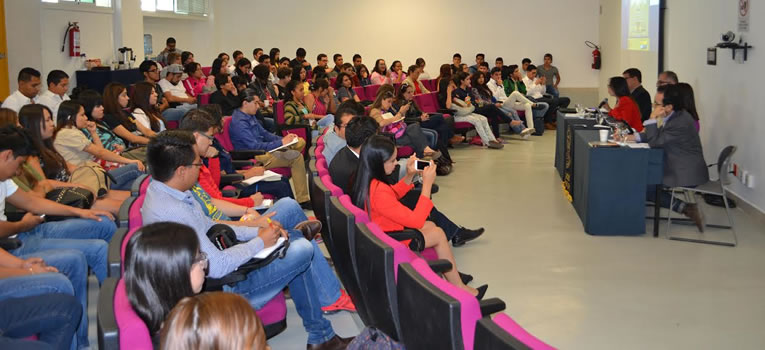
León, Gto., April 14, 2016.- With the objective to generate a thought over the matter of Mexican democracy's challenges and opportunities to the youth throughout the country, there was a panel in the University of Guanajuato Campus Leon under the name "Los retos de la democracia en México" (Challenges of democracy in Mexico).
Dr. Armando Chaguaceda Noriega and Dr. Alex Ricardo Caldera Ortega, professors from the Department of Public Management and Development; Dr. Aquiles Ávila Quijas, professors from the Department of Social Studies, Federal Deputy, Lic. Yulma Rocha Aguilar and the Local Deputy, Lic. Libia Denise García participated in the panel.
Speakers exposed their perspectives on Mexican democracy and the participation of the youth in the electoral processes. There was also a comparison of the democratic processes in Latin American countries in which they remarked the low participation of Mexican society for several reasons that have stayed in the perception among the population regarding the political aspects. They remarked that the Mexican society has a negative perception of the political class, and their governors involved in corruption problems.
In his intervention, Dr. Aquiles Ávila Quijas commented that the use of internet and access to social networks from the youth, where he exposed data that reveal the real impact the use of technology has in the democratic and electoral processes, "there is a scenario in which the youth do not participate and they are not interested in doing so" he pointed-out.
On his behalf, Dr. Armando Chaguaceda Noriega spoke about the scenario from some Latin American democracies and the point in which the Mexican democracy is. He described the road in which the country is going to achieve a better citizen participation with less inequality and increase public policies to be extended for fewer favored sectors within the populations. "Democracy is a live phenomenon, in which cannot exist high salaries from politicians with a poor society," he asserted.
Dr. Alex Caldera exposed the elements to analyze the quality of the democracy in Latin America and took as reference the Mexican case, where he pointed some dimensions such as institutional quality, respect to civil liberties and political rights, capability to generate policies that ensure economic efficiency. With the analysis of the four dimensions, there were graphic to make a comparison on the indexes of civil and political rights, political adhesion vote, gender in the government, among other indicators.
Lastly, Dr. Alex Caldera thanked the attendees for their participation and continues present in the next date of the Seminar "Dialogues about Public Policies for local development."