
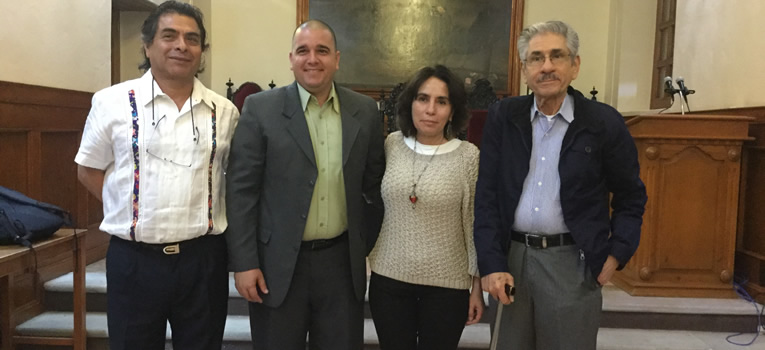
Guanajuato, Gto., April 21, 2016.- Within activities of the Seminar of Cultural and Natural Heritage from the Heritage Excellence Class, that develops with the collaboration of the Department of Culture and Society from the Division of Social Sciences and Human Studies and the Department of Law from the Division of Law, Politics, and Government from the University of Guanajuato, Dr. Andry Matilla participated with the Magister conference "Legal regime of the mining heritage: actual questions."
The objective of the class is to generate an interdisciplinary space so it may be a critic, reflective and creative, based in research, that eases the debate and questioning of concrete and viable proposals and sustainability of the cultural and natural heritage.
About the current challenge of the heritage protection, Dr. Andry Matilla, scholar from the "Universidad de La Habana," Cuba, planted that "Today, the grand challenge of the cultural heritage is not only keeping it but a place in the social traffic of the current people, in harmony with rampant demands from the market and economy; therefore, in an equilibrium that allows their survival not to sacrifice it before other means."
Dr. Matilla exposed in the public –formed mainly by professors, students and people linked with the tourist sector—that the concern in the heritage matter is relatively recent, due to that it emerges after WWII; and in the specific case of industrial heritage, it's been only a few four or five decades back.
The first exercises in defense of the mining heritage appear in England in the 70's, linked to imposed obligations to extracting businesses for the conservation of machinery. He said that it is very important to rescue the physical registry of the industrial activities that, even economically diminished or lost importance, preserve a cultural value: "It's not only about conserving buildings as physical evidence but conserves the spirit of life that underlies that structure."
He mentioned the importance to the regulation of these processes through laws: "We have realized very late that Law is a cultural fact, because in laws, they also express a form of life within the community and a society, with their conditions, evolution and, therefore, tells us a lot about the regent society."
And even if Cuba is not properly a mining country, it does have a very active trajectory in what preserving the cultural heritage refers to, so the scholar shared some applicable cases to the mining heritage of Guanajuato, whose extracting activity has also an important economic weight and where such activity has forged life forms and specific cultural processes around the industrial sector that they need to protect.
To finalize, he highlighted that "The declaration of heritage is an intervention title of the state on a good, that generates rights but also obligations. It is an obligation of the state to protect the heritage, and this is a right of the citizens."