
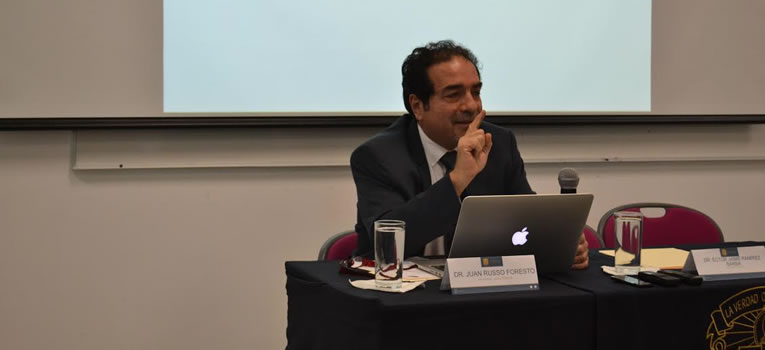
León, Gto., April 28, 2016.- Dr. Juan Russo Foresto, researcher-professor of the Department of Public Management and Development, presented the seminar "Quality of life: Government and Democracy," as part of the annual program made in conjunction with the University of Guanajuato and the National Academy of Medicine of Mexico A.C.
Dr. Juan Russo began his participation pointing out, how, from democracy, there can be a better quality of life in the population can be developed, and can create the opportunities for well-being and access for all the habitants in different countries. He spoke about the aspects that have influenced so that the well-being curve diminishes, even if the income per capita represents an increase in the last 30 years in the American continent countries.
In this sense, exposed that there is an increment in the income and a diminishment in what he called the relational assets which are indicators that show an augmentation in cases of loneliness, isolation feeling, family instability, generational fractures and distrust. In addition, a decrease in social contacts, honesty, solidarity, social participation and social commitment. "If a person consumes, it doesn't increase happiness nor quality of life, what makes people happy is social relations," he remarked.
Likewise, the speaker explained other elements that should be considered by the politicians to broaden the possibilities of social well-being as well as public transport, health, work, and coexistence spaces. He also proposed to norm the publicity directed to children to diminish the culture of consumption and avoid exposure to inadequate messages.
Dr. Juan Russo said that one of the challenges that defy the countries in development is to orient great part to the efforts to improve the spaces where the social relationships generate, and transport, and not necessarily the economic income. He indicated that modern societies are only oriented to production and consumption of assets as a result from publicity and bad politician's practice.
In the same manner, he addressed the lack of credibility in social institutions and politicians, hence; he pointed out that the mission the academic has is to provide spaces to share their ideas and be heard by the politicians. "Our mission is to show things that are possible so politicians can make them happen; democracy is also for the citizens to feel important" he concluded.