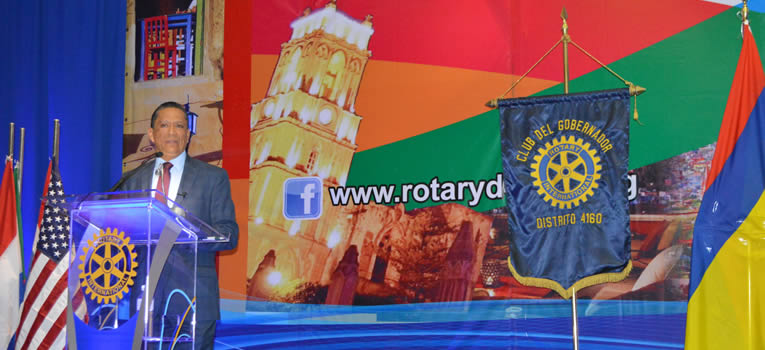
Guanajuato, Gto. April 30, 2016.- The General Rector of the University of Guanajuato, Dr. Luis Felipe Guerrero Agripino, representing this house of studies, participated in the "International Conference of Rotary Clubs," with more than 700 participants from 28 countries.
In the conference titled "The social responsibility of the University," UG's General Rector, spoke of the responsibility of the institution and the influence the students have with society; he pointed out that this house of studies, based on this, has three referents, quality, equity and inclusion.
He assured that in a country that generates more knowledge and knows how to apply it, has greater chances of human development in all the areas, without losing the focus the value content in service to the others, hence, they must form students for the diversity and complexity.
He said that the academic formation had changed, and the most important thing is the learning of the students, so the university faculty must ease the knowledge and accompany. This way, they could generate that the student is open for other knowledge fields, so he can "learn to learn for all his life," assured Dr. Guerrero Agripino.
He added that currently in the universities with social commitment, not only they could develop research, but influence in two elements: entrepreneurship and innovation; so the student is formed and trained in an efficient way.
The main social responsibility of the universities, assured Dr. Guerrero Agripino, is not to lose the human sense, understanding it from its diversity, and inter-culturally; however, from a very important factor which is the construction of a culture for peace.
He finalized by saying that all this is possible if the society works together to achieve these goals, and reaffirmed UG's social commitment by saying that "in the University of Guanajuato, you have to give, before thinking yes."
The event took place in San Miguel De Allende, Guanajuato, with the purpose to raise funds for diverse projects that give a better life quality to society; with workshops and conferences where members of the rotary clubs and 67 students of the Student Exchange program, from 22 diverse countries participated.