
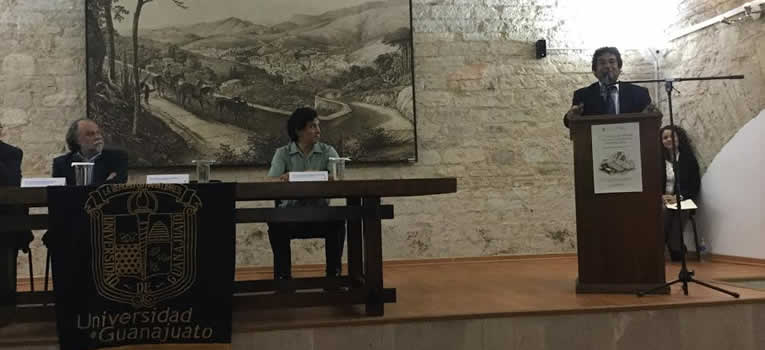
Guanajuato, Gto., May 18, 2016.- The "III Colloquium of Theory and Critique in the Historiographic know-how" began, this event gathers scholars from the Network of researchers in Theory and Methodology in History, students and interested in Theory and History, to analyze for two journeys, the most recent theoretical and methodological problems in the area.
In his inaugural message, Dr. Javier Corona Fernández, Rector of Campus Guanajuato, highlighted the importance it has for the University of Guanajuato (UG) the consolidation of academic networks that diffuse research generated in the departments, at the same time they promote the exchange of knowledge, the dialogue between researchers and students and the interinstitutional collaboration, hence, he congratulated the organizing committee for the work and negotiations made so DCSH from UG hosted the third edition of the Colloquium.
In this encounter, researchers from diverse institutions of the country participate, i.e.: "Benemérita Universidad Autónoma de Puebla", "Instituto de Investigaciones Históricas" from UNAM, "Universidad Autónoma de México-Azcapotzalco", "Universidad Autónoma de Baja California", "Universidad Autónoma de Colima" and, of course, professors from UG, who were in charge of the organization of the event, commented Dr. Miguel Ángel Guzmán, UG scholar and president of the Network.
The opening ceremony was led by Dr. Javier Corona Fernández, Rector of Campus Guanajuato; Dr. Aureliano Ortega Esquivel, Director of the Division of Social Sciences and Human Studies; Dr. César Macias Cervantes, Director of the Department of History and Dr. Miguel Ángel Guzmán López, President of the Network of Researchers in Theory and Methodology of History.
The public activities of the III Colloquium of Theory and Critique in the Historiographic know-how will occur on May 18 and 19, at the auditorium Ernesto Scheffler (venue Valenciana) and in the Library Armando Olivares; these include two Master conferences, four work tables and two editorial presentations. The full program is available at the page of the Department www.historia.ugto.mx