
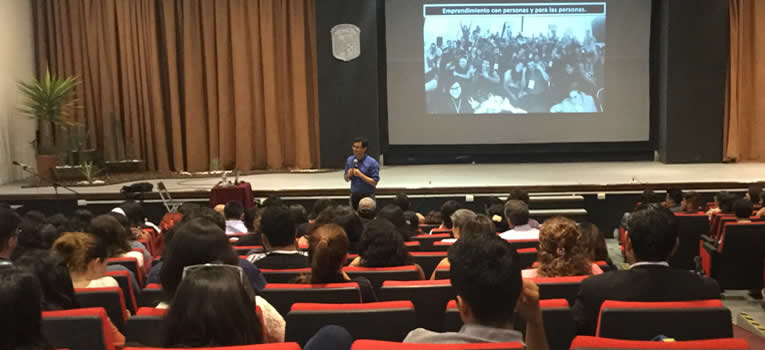
Guanajuato, Gto. a 02 de junio de 2016.- Kind, enthusiast, sure of himself, arrived Edgar Barroso to the auditorium of Campus Guanajuato, invited by the Division of Economic-Administrative Sciences for a double mission: give a workshop for professors and students from Campus Guanajuato already detected as entrepreneurs, and to give the Master conference "Lo que estaremos emprendiendo en 10 años". He doesn't like to say he returns as a "specialist" to his Alma Mater (despite his solid trajectory in the design of projects and entrepreneurship, in addition of his recognized labor as musician), but –in his words— "as friend and as someone who loves the city and the University of Guanajuato".
Before starting his encounter with dozens of youth and professors, he gave us a space to answer some questions about entrepreneurship and education, and about how much the University of Guanajuato (UG) has provided professionally and personally.
What is an entrepreneur for Edgar Barroso?
"For me an entrepreneur is someone that adventures in doing something that don't know if it is going to work or not, but still adventures. In fact, the word has a French origin, which means "adventurer". Cristobal Colón was a great entrepreneur because he started a mission towards the search of something that he didn't knew he was going to find. It is very important to understand it because we use to think of an entrepreneur to someone who starts a business, it is a form of being an entrepreneur, but there are many ways to be an entrepreneur as there are humans on the face of the earth [...] But we are looking at a very important change of the economical paradigm in the world, where institutions are insufficient to offer job to all the youth; and besides the young have other interests, the new generations don't want to be in the same job for 30 years, they want to be in a job then move to another. The economy is changing, I think we have an opportunity because there is a tremendous and creative explosion of our students, so the institutions have to change, since the world of these new generations is very different to the one their professors lived. They have to be prepared to be creative, so they can think critically but also purposeful, that can analyze complex problems and, above all, they can generate solutions to social problems."
You have a workshop today with students and professors, tell us a little of what you'll be talking.
"In the workshop we're going to talk about entrepreneurism programs, of how we can start entrepreneur programs taking advantage of the diversity so spectacular the university has, how we can link them, how we can begin to erase the walls between different schools, and above all, understand how we have to do a system so every entrepreneurism is connected to reality –which may be artistic, it doesn't have to be in completely economic world—but there are things that I have seen in certain places where I've been or that I have implemented myself and I know they work. Here is an example: a problem I see is that institutions make a lot of entrepreneur events, but completely disassociated, what matter is that there is an enthusiasm or an interest but then there is no way to follow up or concrete the project.
So we are to talk about what to do to not have a university that only makes events and go to a university that makes entrepreneurism a culture. Meaning, we give them the creative trust to students and change the university role of only giving knowledge to the student [...] We have to change education in its roots, because, as I was saying, the world this kids are going to face is something else, and will be thrilling, but we have to prepare them for a very changing and demanding world in many senses."
The collaboration and extension are every time more important topics for UG, what do you think?
"[...] Especially in a country like Mexico, where the social differences are so strong, we have to make our students face the reality of their country, because universities live in an ivory tower, and understanding the other, understand why the high percentage of youth who cannot access the university or why are we not creating them job opportunities, so we are not giving them more option than to do informal things or illegal, and if we don't change that perception of the other, what is going to happen is having a society more and more fragmented, every time more isolated, which will result in completely disarticulated country. What I can tell you is that any organization that doesn't know how to collaborate will disappear. If you look, the technological progress we've had in the last years are not work of one person but a team, so we are no longer in the time of the "genius", where there was a person who was a genius and everything came from there, but people who can articulate many talents –and here comes the transdisciplinary collaboration—for a same goal."
What platform gave UG to you for what you developed in your career?
"This University gave me everything I needed. I had very good teachers, others not so good, but there was enough to be with them and learn a lot. I studies music here, back when José Luis Castillo was director of the Symphonic Orchestra of the University gave us access to the rehearsals, lend us the music sheets and that was fundamental for my musical formation [...] Master Héctor Quintanar was a medular stone in my education.
But also, gave great friends, great experiences. I had the chance to see, every year in the Cervantino, first level events, which also raised my artistic standard, because I could see what I need to aspire to."
In the distance, how do you see UG? How much it's changed for you?
"In the distance I see it growing tremendously, I see new buildings everywhere, new departments. But, I think I would love to see a more articulated university, more solidary, maybe more focused in creating knowledge which is useful for people, obviously you also need theory, both are very important [...] But in the distance I see they have made a very interesting job, and would have to check, how we shape education for 2020-2025, which is when our students truly will be working [...] And this will change, because the study programs are very rigid, in my point of view, and we have to make a more flexible university, to adapt to the talents and the interests of the students and not the program designed for everyone. Standardized education is in intensive therapy, but we don't realize it, and that education will no longer work for the students as it used to."
Edgar Barroso is a graduate in Music, from the University of Guanajuato; Master in Digital Arts by the University Pompeu Fabra of Barcelona and got his Ph.D. from Harvard University. In 2015 he entered the National System of Art Creators and received the prize of "Ibermúsicas" composition. Currently, he is an associated professor in the School of Government and Public Transformation of the Tecnológico de Monterrey where he performs as director of the laboratory of Entrepreneurism and Transformation. Edgar combines his career as composer, entrepreneur and designer of laboratories of innovation, entrepreneurship and education.