
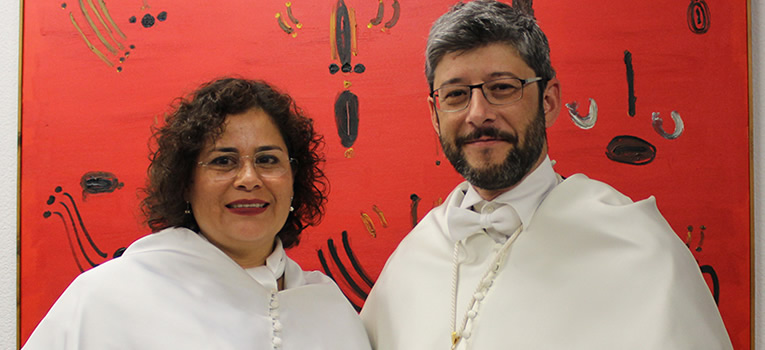
Guanajuato, Gto., July 1, 2016.- Ph.D. Cynthia Villagómez Oviedo, professor and researcher at the Department of Design of the University of Guanajuato, has been awarded with the Extraordinary Prize of Doctoral Thesis, at the Universidad Politécnica de Valencia (Spain), for her research "Análisis de procesos de producción artística digital en México: artistas digitales mexicanos y su obra."
This prize is only given to the 10% of the thesis generated in all areas of study of the Universidad Politécnica de Valencia every year, in arts they gave only three, from which one was granted to Ph.D. Villagómez for her broad work during her research in the new art trends.
"Art is a reflection of life, from the time we live in, that is why I had the uneasiness to take this subject, for the artistic aspects linked to the use of digital technology and what it represents today" that is how Ph.D. Cynthia Villagómez Oviedo expressed.
For seven years of research she is satisfied and happy for the results, since she assured that during this process the concept of art is rediscovered. For a long time, art was defined as something that could be done with the talent of a painter, sculptor, etc., by the own hand of the artist; today, this concept is changing, the artist has to be an intellectual, capable of generating ideas, questions and also reflections of the reality that is around.
In her approach, she says that Digital Art is a lowly explore vanguard topic, so in the development of her research se warned from other forms in the artist's evolution when technology is used as a mean and a form of expression. It was through a research in Europe, in several specialized centers in Art with the use of technology in Mexico, as well as the analysis of eight Mexican digital artists, that covered the research; and now the works can find a path through the computer or are used for the creation process.
For Ph.D. Cynthia Villagómez Oviedo, the challenge was to know and deduct which were the works in which technology was used that entered the category of Digital Art, since it is something complex since the processes and methods in the elaboration or art are diverse and most times remain hidden to the public.
A computer can be a mean or can be in the piece of Digital Art, such is the case of the Mexican digital artist, Leslie García, who has many pieces of software design and develops projects of Electronic Art and digital means, where she explores the fusion process between art, science and technology as can be appreciated in her site http://lessnullvoid.cc/content/
Another example of Digital Art is the work of Santiago Itzcoatl and his work "Sismo_lógico" which is about a great size sphere with several lights that are lit and speakers which emit a sound in real time when there is an earthquake in any part of the world, since it is connected to an international earthquake network which is visible through a monitor exposed within the exhibit room next to the sphere.
This research highlights that the digital pieces invite to the reflection on different topics, there are artists with digital works, nevertheless, they also analog electronics. Such is the case of the Mexican artist and pioneer of the Net.Art in Latin America, Arcángel Constantini. On the other hand, his works play with computer errors or "glitch," transmitting the idea that the error links the computers with human beings, meaning, the computer is an artifact done by men, which is not perfect and therefore, neither are its creations. People have a tendency to think that technological artifacts are oblivious to human beings –as if they had life of their own—, but are human creations, so, they are a part of us.
During the interview she added that art has a commercial trend, where only few have the opportunity to appreciate the artistic work. Nevertheless, today there are Digital Art works that can be appreciated massively, is the case of which are produced in the internet (among others), where the user can access for free and so, everyone has access to this form of art.
Finally, she added that it was a great effort to make this research, but invites to be perseverant assuring that "... being perseverant, sound easy, but living it is different, so you have to look for the best way to be perseverant by dedicating to that we really like and enjoy, if what we do currently doesn't satisfy us, we must find the area that does to be capable to give the best from ourselves, that will make the difference between a full person and mediocrity..."
Among her future plan is to address and contribute in new projects such as the Iconographic systems of the Ancient Book, as well as to continue researching on the new processes of Digital Art and their link with Design, so with this knowledge we can support UG students.