
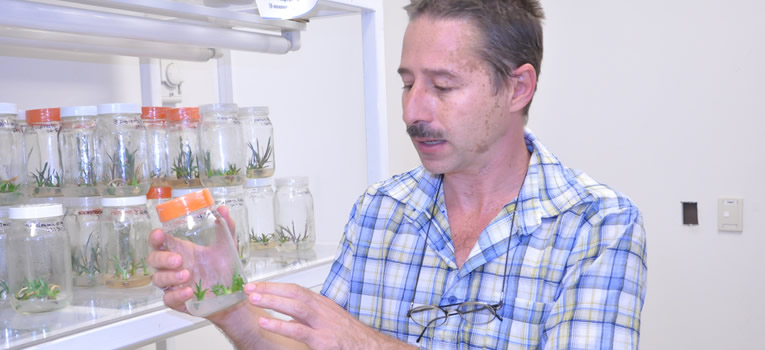
Guanajuato, Gto., July 11, 2016.- Researchers at the Laboratory of Culture of Vegetable Tissue of the Division of Life Science (DICIVA) of the University of Guanajuato seek to find solutions to the social-economic problem many farmers in the region suffer.
This is proposed through the culture of agaves that grow from a temporary immersion technique. Dr. Héctor Gordon Nuñez Palenius from the University of Guanajuato and the guest professor, Dr. José Alfredo Herrera Isidrón from the Universidad de la Habana, as a multidisciplinary team, are the best entrepreneurs of this project.
Through the temporary immersion system, they pretend to multiply the agave plants, for this, they are requesting support from the National Council of Science and Technology (CONACYT) and take this methodology to the rural producers.
In an interview, Dr. Herrera Isidrón explained that this project has the purpose to fight water shortage cause by climate change, since the rain season is brief and so hinders the work of the farmers. In the same way, he indicated that 54% of the Mexican territory is arid or semiarid, that is why the vital liquid is missing.
"This situation affects small producers who don't have the capacity to adapt and take care of their cultures and at the same time, feed their animals. The common crops such as tomatoes and corn cannot be successful because they need water and its absence, so people have to abandon their lands. What we are proposing is substituting these cultures for agave, a plant adapted for drought but using methodologies that we would like to apply", pointed Dr. Herrera.
He exemplified by saying that there are several communities who are impoverishing because the lack of water and they have thought in these sectors to offer a survival alternative or improve their life conditions with the culture of agave, same which will substitute the traditional cultures.
Dr. José Alfredo Herrera Isidrón commented that the agave has the advantage that it has been a very studied culture in diverse universities and that it can also become food or forage to feed the cattle.
He highlighted that the producers can also take advantage of diverse derives from agave such as mead, pulque, honey, selling agave to companies that dedicate to produce tequila or mezcal, to mention some.
Reearchers pretend to offer an alternative to improve their social situation, "the people who benefit will need a training through a course or a module. We are at the stage of seeking the necessary resources so this can become real, we are talking with diverse authorities on the matter," he said.