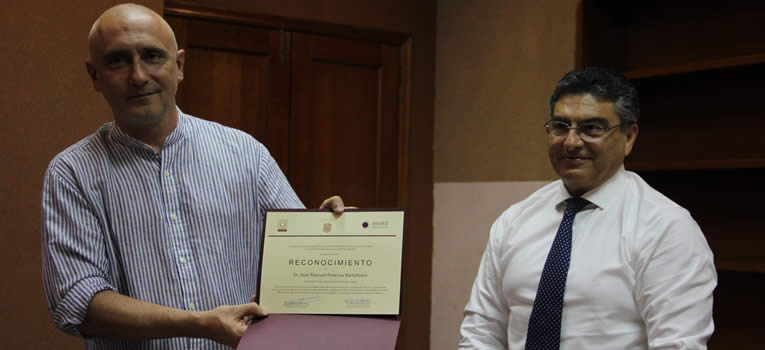
Guanajuato, Gto., July 26, 2016.- The head professor and researcher from the Universidad de Alcalá in Spain, Ph.D. Manuel Pedrosa Bartolomé, visited the University of Guanajuato (UG) to participate in a talk about Oral Literature, coordinated by Ph.D. Gabriel Medrano and by the Intercultural Study Network from the West Central Region of the National Association of Universities and Higher Education Institutions (ANUIES for its acronym in Spanish).
The event was held with the intention to speak about the importance and the evolution the oral literature has today. Ph.D. Pedrosa Bartolomé is a specialist in the subject, due to his interest for folklore and costumes of popular cultures.
He indicated that the orality "is the cultural corps that is transmitted through voice." At first, he said that the oral narration emerged as written literature, because the first goes back a thousand years when the human being began to articulate words and pronounce the first magic incantations to hunt, the ritual chants, the stories to transmit knowledge, etc.
Ph.D. José Manuel Pedrosa highlighted that, even if writing seem to have displaced oral literature, currently orality is a very interesting process of reorganization, due to the progress of technology and specifically internet as a tool.
He affirmed that internet is the place where orality is re-emerging and occupying the place the book had, since actual society is going towards a more audiovisual perception, in such form that the Spanish researcher proposes a "Neo-orality", linked to technology.
The attendants to the event –formed by students, researchers and members of ANUIES—, had diverse interventions during the talk, where they covered topics such as: oral narration and linguistic diversity of Mexico, the displacement of the book by electronic devices, the evolution of the oral and written language, as well as the commercialization of the intangible heritage from the great editorials.
It is worth mentioning that Dr. José Manuel Pedrosa is a renowned philologist born in Madrid. During his academic career, he has published a great number of books and 200 scientific articles.